FEATURED ARTICLES
Naman Gosalia Is Advancing a New Era of Cardiovascular Prevention. The Conversation Has Reached the United Nations.
Naman Gosalia is advancing AI-enabled cardiovascular prevention, bringing evidence-based healthcare innovation to the United Nations Global AI Governance Dialogue to promote continuous, scalable heart disease prevention worldwide.
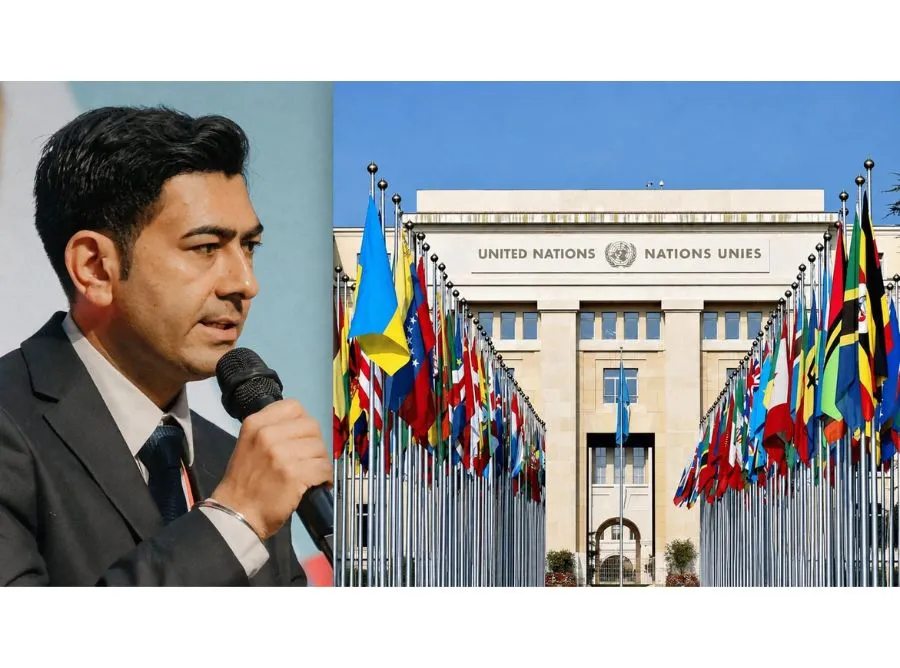
The Founder of AnginaX Taking the World’s Largest Killer to the United Nations AI Governance Dialogue
Geneva [Switzerland] As the United Nations convenes the inaugural Global AI Governance Dialogue, Naman Gosalia is bringing a healthcare perspective focused on one shared goal: helping translate modern medical science into continuous cardiovascular prevention through Responsible AI, evidence, interoperability and implementation so that millions more lives can be protected.
Every year, cardiovascular disease claims nearly 20 million lives, making it the world’s leading cause of death. Millions more live with heart attacks, strokes and lifelong disability, while the economic burden continues to rise across every region of the world.
For Naman Gosalia, these are far more than public-health statistics.
” These are not just numbers. They are families. They are parents. They are brothers and sisters.”- he quoted at World Economic Forum.
Despite extraordinary advances in cardiovascular science, precision medicine and digital health, one question continues to challenge healthcare systems everywhere:
Why are we still losing so many lives to a disease that is increasingly preventable?
That question has become the life’s work of Indian founder Naman Gosalia.
Speaking during a panel hosted by the World Heart Federation earlier in May this year; he summarized his philosophy in one sentence:
“We understand the pathobiology of atherosclerosis in remarkable detail. The gap is no longer science; it is operational.” “Cardiovascular disease has been screened for decades. What has never been successfully embedded into healthcare systems is continuous cardiovascular prevention.” he added.
Today, measuring blood pressure has become a routine part of almost every healthcare interaction. Cardiovascular prevention, he argues, should become just as fundamental; not an occasional screening event, but a continuous, longitudinal part of routine healthcare.
” A patient walking into Mount Elizabeth in Singapore, AIIMS in India, Mount Sinai in the United States, or a rural clinic in Africa may experience very different healthcare systems. But one gap remains strikingly similar across them all: cardiovascular prevention is rarely continuous, longitudinal and operationally embedded into routine care.” he raised in World Heart Summit in Geneva.
According to Gosalia, this is the challenge AnginaX was created to address.
Rather than treating prevention as an isolated event, his vision is to make it a permanent layer of healthcare, integrated into clinical workflows, informed by the latest medical science, supported by Responsible AI, and designed to help physicians, healthcare systems and governments deliver consistent prevention at population scale.
Modern cardiovascular medicine has evolved rapidly, with advances in precision medicine, individualized risk assessment and advanced lipid science. Yet much of routine prevention remains generalized and fragmented making it difficult for healthcare professionals to consistently translate these advances into everyday clinical practice.
For Gosalia, Responsible AI is about helping healthcare professionals apply rapidly expanding medical knowledge earlier, more consistently and more equitably, while keeping physicians at the Centre of every clinical decision.
That philosophy recently became part of a much broader international conversation.
This week, Gosalia participated in the inaugural United Nations Global Dialogue on AI Governance in Geneva, joining global ministers, diplomats, Member States, scientists, academia, civil society and industry leaders in discussions on how artificial intelligence should be governed to benefit humanity.
The Dialogue established under the mandate of the United Nations General Assembly focused on evidence, interoperability, capacity-building and practical implementation across sectors.
Bringing the perspective of cardiovascular disease prevention into that discussion, Gosalia emphasized that healthcare presents a unique governance challenge.
“Heart attacks are not only a clinical crisis. They are a social, economic, geographic, nutritional and environmental crisis, a silent pandemic hiding in plain sight.”
His perspective also highlighted that while common principles for AI governance are essential, implementation cannot be identical across every sector.
Healthcare, he argues, carries unique risks, unique evidence requirements and unique human consequences.
Throughout the Dialogue, discussions with representatives from numerous Member States reinforced a shared commitment to evidence-based governance, interoperability and ensuring AI serves people across different national contexts.
Reflecting on the message he shared during the United Nations Global Dialogue on AI Governance, Gosalia said:
” History has a way of remembering the moments when humanity chose to act. I hope the world looks back on 2026 as the year we moved beyond discussing prevention and began making it part of everyday healthcare. We already have the science. We have precision medicine. We have digital infrastructure. We now have Responsible AI. If we use these responsibly to prevent millions of heart attacks and strokes before they happen, that will be one of AI’s greatest contributions to humanity. History will not remember us how the AI governance frameworks were created and whether humanity benefited because we did. Humanity must always come first.”
As governments, scientists, healthcare leaders and innovators continue shaping the future of AI governance, Gosalia believes healthcare offers one of the clearest measures of success: not by the intelligence we build but by the lives we help protect.