HEALTHCARE
What Is PGT and What Does It Tell You About IVF Embryos? Understanding Preimplantation Genetic Testing in Vadodara
This article explains how preimplantation genetic testing helps assess IVF embryos, clarifies PGT-A and PGT-M, and outlines when testing may support informed fertility treatment decisions in Vadodara.
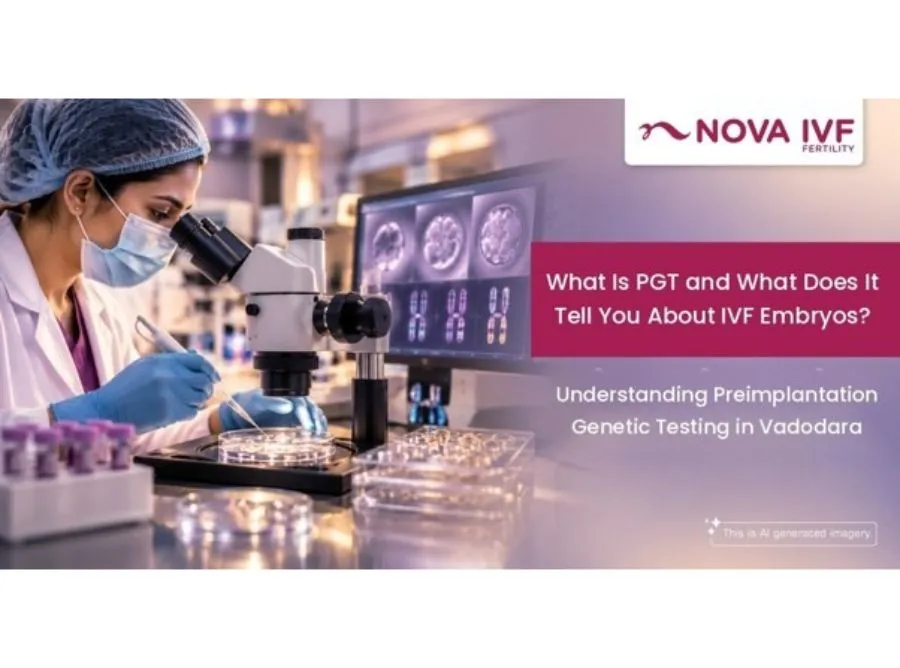
What Is PGT and What Does It Tell You About IVF Embryos? Understanding Preimplantation Genetic Testing in Vadodara
Several embryos can be created during IVF, but they do not all have the same genetic makeup or the same potential to develop. Under the microscope, an embryo's shape, cell arrangement and stage of development can be assessed, but its appearance alone cannot tell you whether its chromosome number is normal.
This is where preimplantation genetic testing (PGT) can be useful. A few cells are taken from an embryo created during IVF and analyzed genetically. However, PGT should not be seen as necessary for every IVF patient, or as a test that guarantees success. Whether to use it depends on the specific medical situation and the goal of treatment.
What Is PGT, and What Does It Try to Find Out About an Embryo?
Preimplantation genetic testing is a form of genetic screening done alongside IVF. Typically, the embryo is grown to the blastocyst stage. A few cells are then taken from its outer layer and sent to a specialized laboratory for genetic analysis.
The type of PGT depends on the question you want answered. PGT-A is mainly used to check whether an embryo has a normal number of chromosomes. PGT-M may be used when a couple is at risk of passing on a specific inherited single-gene condition, to look for that particular genetic change. So hearing the term "PGT" is not enough. Before treatment, you need to understand which type will be done and what information it will give in your case.
What Does PGT-A Tell You About an Embryo's Chromosomes?
Human cells normally have 23 pairs of chromosomes, 46 in total. Sometimes an embryo has an extra or a missing copy of a particular chromosome. This is called aneuploidy.
In some cases, chromosomal abnormalities like these are linked to problems with embryo development, implantation or a pregnancy continuing. The aim of PGT-A is to get this chromosomal information before the embryo is transferred.
However, a PGT-A result is not a certificate of an embryo's overall health. It reports the chromosomal information from the sample that was tested. The condition of the uterus, the endometrium, how the embryo develops, the mother's age and other reproductive factors also play a role in the outcome of a pregnancy.
What Is the Difference Between PGT-A and PGT-M?
Both PGT-A and PGT-M are genetic tests, but they serve different purposes. PGT-A focuses on finding abnormalities in the number of chromosomes in an embryo. PGT-M, on the other hand, may be used when there is a known risk of a specific inherited single-gene disease in the family. In that case, the embryo is tested for whether that particular genetic change is present.
PGT-M often requires genetic diagnosis and laboratory planning before treatment even begins. So it is important for couples to give their fertility specialist complete information about any inherited conditions in their family.
At Which Stage of IVF Is PGT Done?
PGT is not done directly on the egg or on an early-stage embryo. First, the ovaries are stimulated to produce several eggs. After the eggs are retrieved, they are fertilized with sperm, and ICSI may be used if needed.
The embryos are then grown in the laboratory. For embryos that reach the blastocyst stage, a biopsy is done when it is required. A few cells are sent for genetic testing, and the embryo is usually cryopreserved. Once the result is available, a medical decision is made about which suitable embryo to transfer. In this sense, PGT-A is part of the laboratory process that takes place before embryo transfer.
Does PGT Definitely Improve IVF Success?
This is the point that calls for the most caution. Current evidence has not shown that using PGT-A as routine screening for every IVF patient clearly improves live birth outcomes. The American Society for Reproductive Medicine's 2024 opinion also says there is not enough evidence to support routine PGT-A use for all IVF patients.
For some patients, genetic information can help guide treatment decisions, but it is not accurate to present PGT as "a necessary step for successful IVF." PGT also involves additional procedures, including embryo biopsy, cryopreservation and genetic analysis. Sometimes no result is obtained, or a mosaic result is reported. That is why it is important to understand the possible outcomes and limitations before testing.
What Does a Mosaic PGT Result Mean?
PGT sometimes reports a mosaic result. This means the cells sampled from the embryo do not all have the same chromosomal makeup. It would be wrong to assume that such a result automatically means the embryo is unsuitable for transfer. Interpreting mosaic results can be complex, and in such cases genetic counseling and guidance from a fertility specialist are essential. Before testing, couples should be told about the possibility of a mosaic result, no result, and a false or limited result.
What Factors Can Influence the PGT Decision in Vadodara?
The decision about PGT is never based on a single factor. The woman's age, any history of miscarriage, inherited conditions in the family, the results of previous IVF cycles, the number of embryos created and the number that reached the blastocyst stage can all come into the discussion.
If there is a specific genetic disease in the family, PGT-M may be discussed. The decision to do PGT-A, on the other hand, is made when the goal is to learn about an embryo's chromosomal status. So when talking with a fertility specialist in Vadodara, the most useful question is not simply "Should I do PGT or not?" It is better to understand "What information will this test give me in my case, and what will change in my treatment because of it?"
PGT and Genetic Evaluation at Nova IVF Fertility, Vadodara
At Nova IVF Fertility in Vadodara, IVF treatment can be planned together with embryo development and any genetic evaluation that is needed. Services such as IVF, ICSI, cryopreservation of eggs, sperm and embryos, fertility preservation and genetic testing of embryos are used according to the needs of each case.
Treatment at the centre is planned around the patient's medical condition, reproductive history and the goal of treatment. So the decision about PGT can be treated not as a stand-alone step, but as part of the overall IVF plan.
The Role of Dr. Himani Patel at Nova IVF Vadodara
Dr. Himani Patel, who is associated with Nova IVF Fertility in Vadodara, holds an MBBS and an MS in Obstetrics and Gynecology, along with a fellowship in reproductive medicine. She works as an IVF and infertility specialist and has experience in treatments such as IUI, IVF, fertility preservation and hysteroscopy.
When deciding on an advanced test like PGT, it is important to look at the patient's previous treatment history, embryo development and genetic risks together. So it makes sense to discuss the purpose and possible use of PGT with a reproductive specialist such as Dr. Himani Patel of Nova IVF Fertility Vadodara.
What Questions Should You Get Answered Before PGT?
Before testing, a couple should understand which type of PGT will be done, what genetic information it will provide, how many embryos may be suitable for testing, what will be done if the result is mosaic or inconclusive, and how the embryo transfer plan will change once the results are in.
It is also necessary to have a clear discussion about the benefits and limitations of PGT, the additional procedures involved, and the cost. A decision about genetic testing makes more sense when the couple understands how the information it provides can affect the next steps of treatment.
PGT Is Not About More Testing, but About Answering the Right Question
Preimplantation genetic testing can help provide specific genetic information about IVF embryos, but it does not guarantee an embryo's full potential or a pregnancy. So when choosing the best fertility clinic in Vadodara, what matters more than whether advanced technology like PGT is available is understanding why it is needed in your case.
At Nova IVF Fertility in Vadodara, fertility evaluation, IVF, ICSI, embryo care, cryopreservation and genetic testing can be considered within the context of the patient's overall treatment plan. Ultimately, PGT is best used when it answers a specific medical question and helps you make a better-informed decision about treatment based on that information.